String Art and Math a Project in Multiplication String Art and Math Pdf

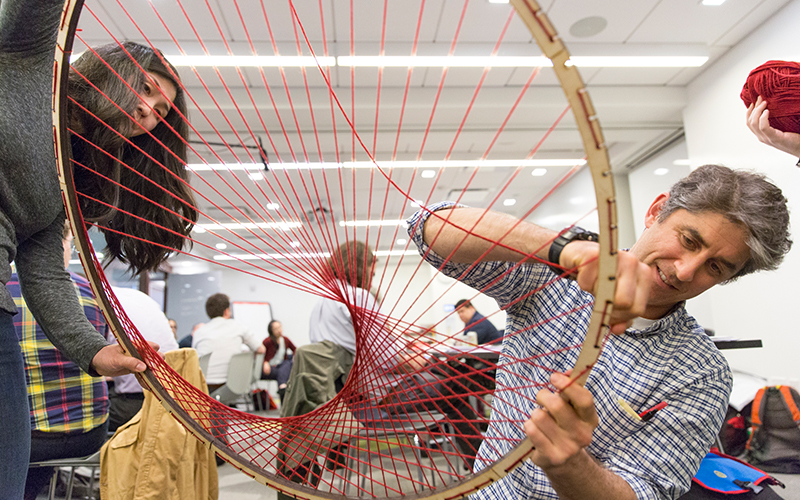
Rings and Strings
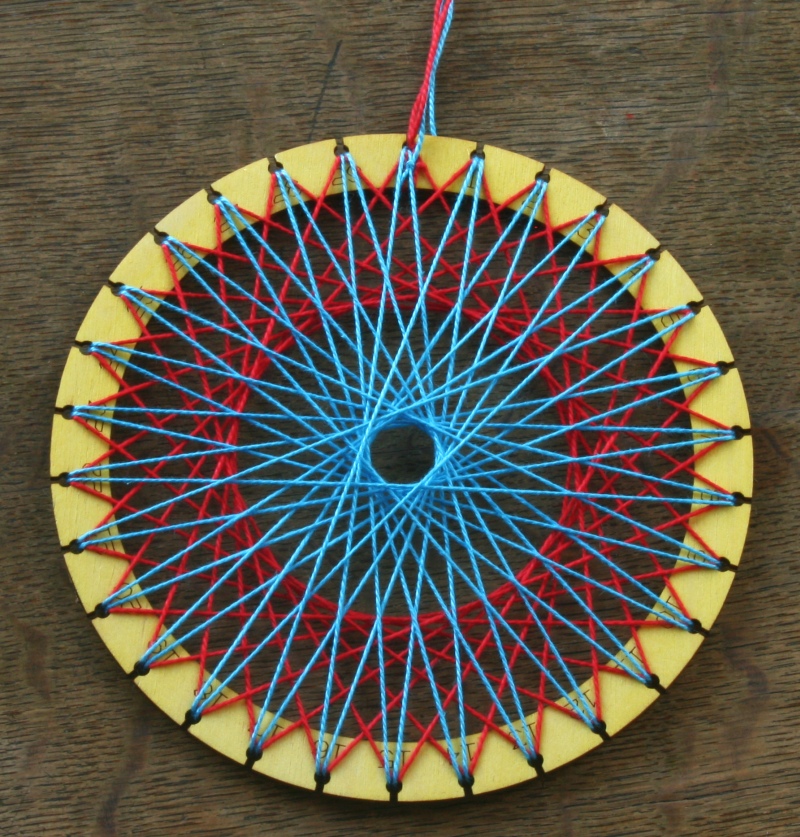
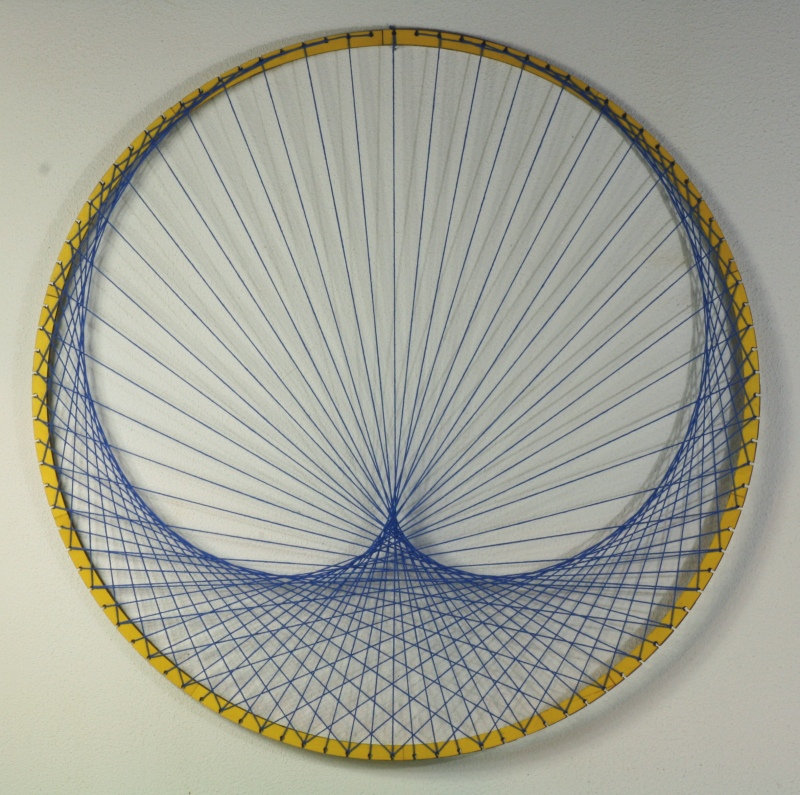
The basic pattern is to connect each pigsty with the hole k steps away. This creates a round opening centered in the band, tangent to each string. Doing this with one continuous string introduces a secondary problem of how to connect the visible segments using short segments on the back. Then multiple patterns of different colors and with unlike values of k can be combined on one ring to create more interesting designs. An optional extension is to move from addition to multiplication, by connecting each pigsty i with hole 2i, which creates a cardioid shape from the tangents.
String curves have a long history in mathematics education, going dorsum to Mary Everest Boole, wife of the mathematician George Boole. A classic 1906 book by Edith Somervell popularized the subject. Nowadays, the terms "curve stitching" or "string fine art" are used for variations of this activeness; searching for them will produce many boosted resource.
This activity provides rich classroom material for teachers following the Common Cadre Standards for Mathematical Practice. This lesson too provides cantankerous-curricular connections to art and compages.
Detailed Instructions for String Rings
Time Required: ane 60 minutes
Materials
- 2 copies of the 30-dot paper handout per pupil
- colored pencils
- 12-inch rulers or other straight edges
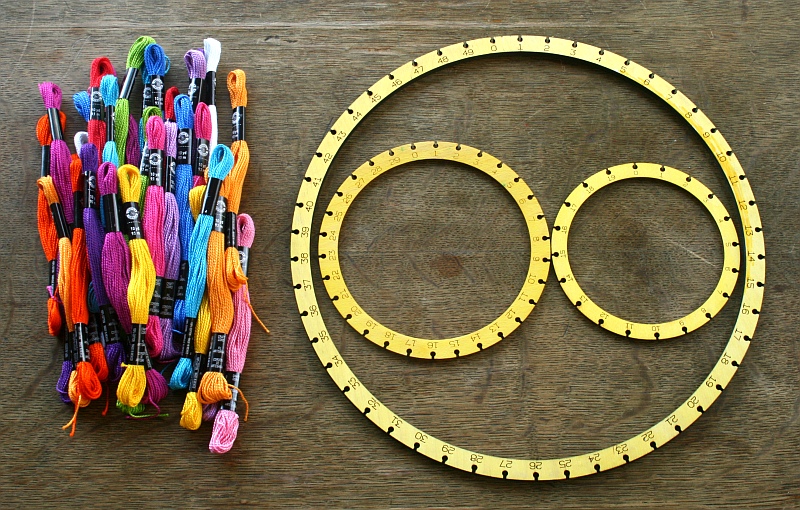
- laser-cut wood rings, using this template (ruby=cut; blueish=etch)
- embroidery thread (one 8-yard or x-yard skein per educatee, due east.g. a multicolor package like this)
- pair of scissors to cut the thread
- optional: handouts with 50 dots or 100 dots that can be used for follow-on activities
- The band templates can exist scaled to be larger or smaller in bore. Select the number of holes appropriate to your pupil's level. For elementary students, a six-inch bore, 30-hole ring is a good start. For 6-inch diameter rings, 1/8 inch thickness plywood works well. For 1-foot diameter rings, apply one/4 inch thickness.
- Larger rings can be assembled from arcs, equally described below.
- Nosotros colored the rings shown here with a bright yellow h2o-based stain.
- The 30-hole ring, calculation by ten is the easiest way to begin.
- Nosotros found that the string aspects of this activeness are difficult for many 2d grade students, even though they tin practise the "minds on" drawing part.
2. Discuss the numbering of the dots. You tin can point out that mathematicians often like to start counting at zero. It is a natural beginning. The dots are numbered 0 to 29, so there are
30 dots. Tell students that if they ever demand larger numbers, to work as if the numbering keeps goes around, eastward.k., on a 30-dot sail, after 27, 28, 29, you can act as if the next dots are 30, 31, 32 should you e'er need those numbers (fifty-fifty though they are labeled 0, 1, two) . With older students you lot can discuss "clock arithmetic" or say to do everything modulo thirty.three. Ask students to apply their straightedge to draw a line from dot 0 to dot 10. And another line from 1 to 11. And some other from 2 to 12, and generally from each dot i to dot i +10.
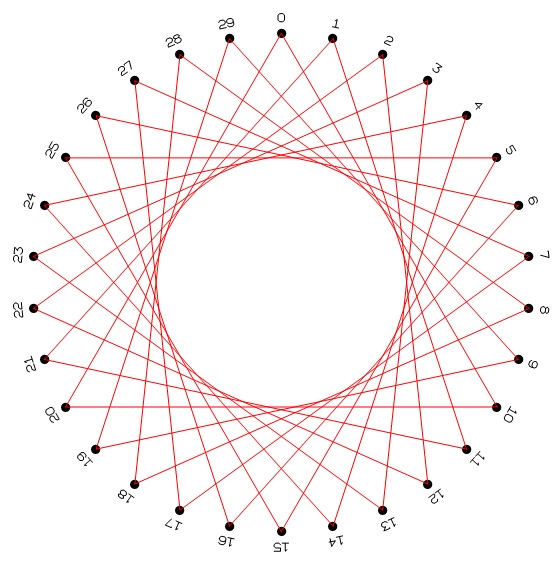
four. For the last x lines, students will meet how the numbers 0-9 are used again to represent 30-39 , e.m., the line from 27 to 37 ends at the dot labeled seven. The result should be like the pattern shown here in carmine. Indicate out that "neatness counts" in the sense that the pattern will look better if the lines are straight and go directly from dot to dot.
6. Discuss the results and the effect of the different choices for k. Students who chose a smaller number, i.e., thousand < 10, will have a large opening, because the lines stay nearer the circumference. If a student chose k=ane, the result is but i large 30-gon and the lines never cross. Values in the range 10 < one thousand < xv requite a smaller central opening. If a student chose grand =15, the lines all cantankerous at the middle. If a educatee chooses a number m that is larger than xv, the result is the same every bit if they chose 30-k, for instance, choosing 29 gives the same diagram as choosing one; or choosing 20 gives the same diagram as choosing x. Hash out why. (Answer: Because of the "clock arithmetic," going frontwards 29 is the same as going backwards 1; going frontwards 28 is the same every bit going backwards two, etc.). What option would give the smallest pigsty? (Answer: xiv or sixteen.) For students familiar with negative numbers, you tin can discuss how 29 = -1, modulo thirty, etc. and choosing yard gives the same upshot equally choosing -chiliad considering it gives the same prepare of lines when thought about from the other end, i.e., line that goes from i to i + 20, when thought nearly from the other end goes from (i + 20) to (i + xx) + ten).
Office B . Hands On. Rings and Strings
8.
Students tin each choose whether the side with numbers or the side without numbers will be the front end. Every time the thread goes through a hole, it switches from forepart to back or from dorsum to front. 9. Explain to students that they will run the thread through the holes of the ring to make a blueprint, just that we want the blueprint to be all on 1 side of the ring, so it tin can exist fully seen, not partially hidden on the back. Whatever side is forepart, we want the lines nosotros "describe" in thread to be on the forepart, and so we need to make short connecting hops on the back of the ring, coordinating to when y'all lift upward your pencil at the end of one line and move to the first of the side by side line. Ask if at that place is a systematic way to do this. Discuss ideas. I matter to hash out is that information technology will look the same in the cease no affair what society the strings are placed; you lot don't need to practice the strings in the lodge 0, 1, 2, iii, ..., as long as each string segment is the aforementioned length and yous eventually do all thirty of them. And another idea is that a sting from a to b looks simply like a cord from b to a, so it would be OK to go backwards if that always helps.Note: At that place are two natural ways we have institute to run the strings continuously, using curt hops on the back. We call them the "Dorsum and Forth" method and the "Skip Around" method. The back-and-forth method is slightly more complex, but works the same way for whatever yard. The skip around method is more symmetric and more interesting to think about how and why it works, but you accept to pick a good move for the dorsum depending on the choice of chiliad, so we recommend it for older students.
10. The Dorsum and Forth Method. The easiest manner to make all the lines is to alternate going forward and backward, e.g., going forward from i to i + k when i is even and going backward from i + k down to i when i is odd. (It is easier to do than to explain.) For instance, if thousand is ten, get from 0 to 10 on the front, and so to 11 on the back, and from 11 downward to i on the front. Then become from 1 to 2 on the dorsum and you are set up to go frontwards again. In this way, the segments are made in social club 0, 1, 2, 3, ..., but half of them are done "backwards" from the loftier number to the depression number.
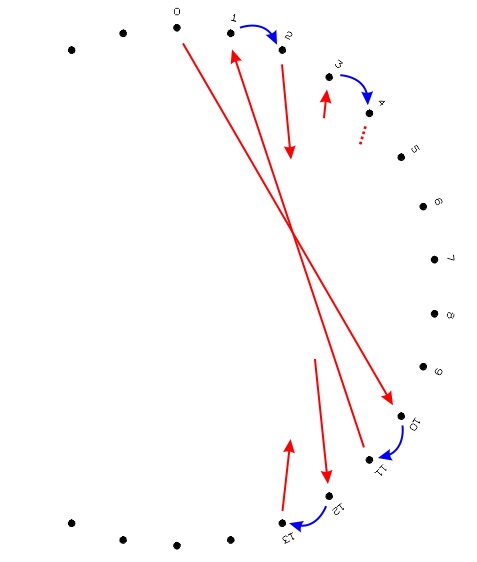
11. Explain the method, perhaps drawing a diagram on the board similar the image above. In this diagram, the scarlet represents the segments on the front that we want to "draw" with the thread. The blue represents short hops on the back to move usa to the next segment.
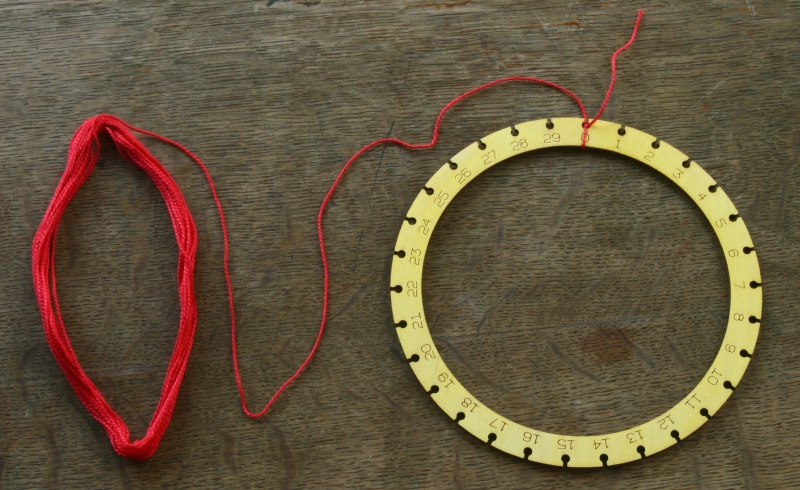
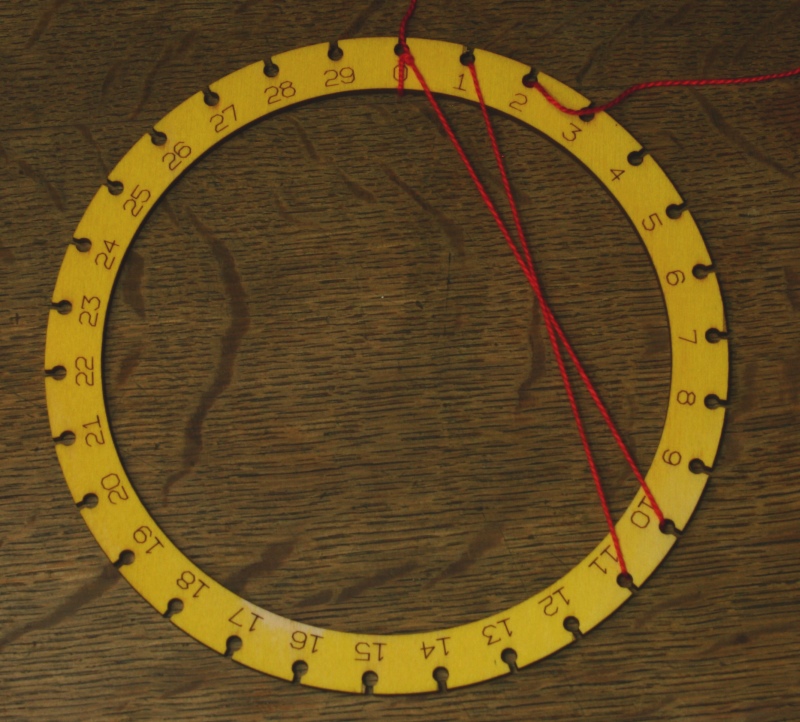
13. Go from 0 to ten on the front, to 11 on the back, from 11 down to 1 on the front, and then to 2 on the dorsum. This is 1 dorsum-and-forth sequence. Keep the string fairly tight, so the lines stay straight and volition non fall out of the holes.
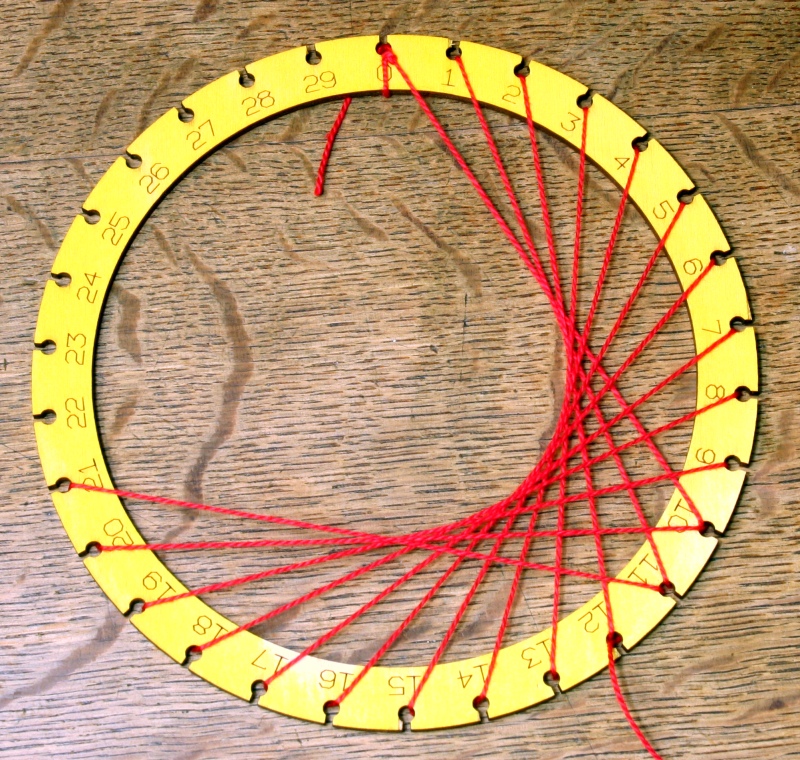
fourteen. Continue with the back-and-forth moves. Y'all become forward k from the even numbers and you go back k to land on the odd numbers. Later each back-and-forth, you have completed two of the 30 desired lines and fabricated two small connecting hops on the back.
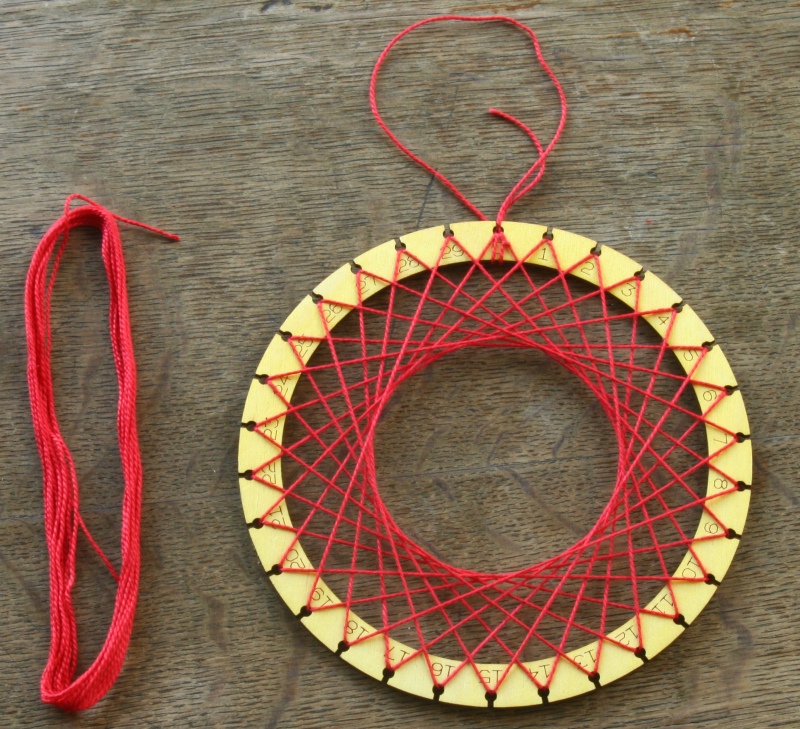
15. Y'all should eventually stop up back at 0 subsequently making all 30 segments. Cheque that everything is right and tie off the end. Y'all can leave a hanging loop for displaying it.
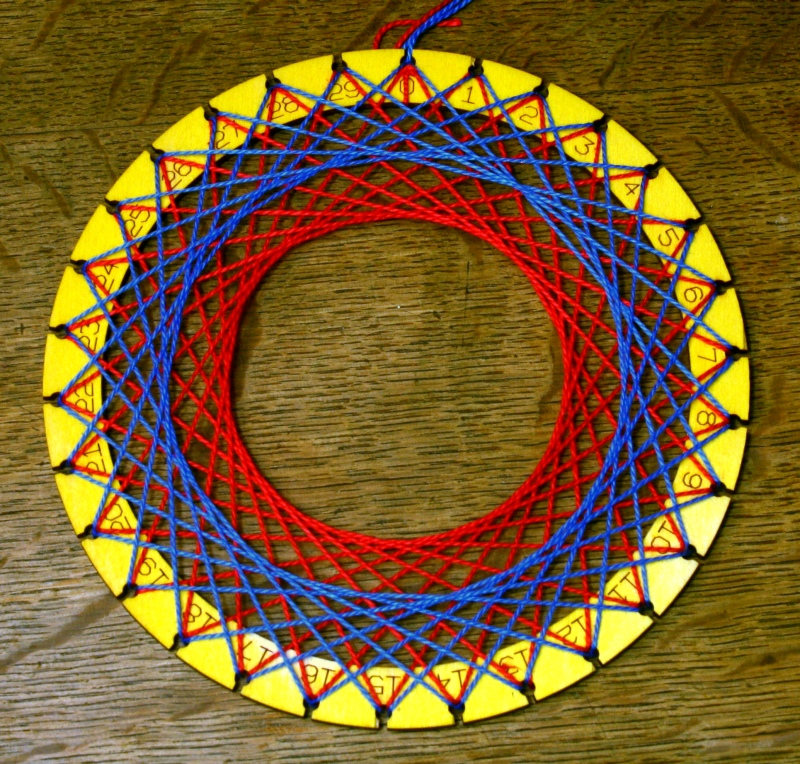
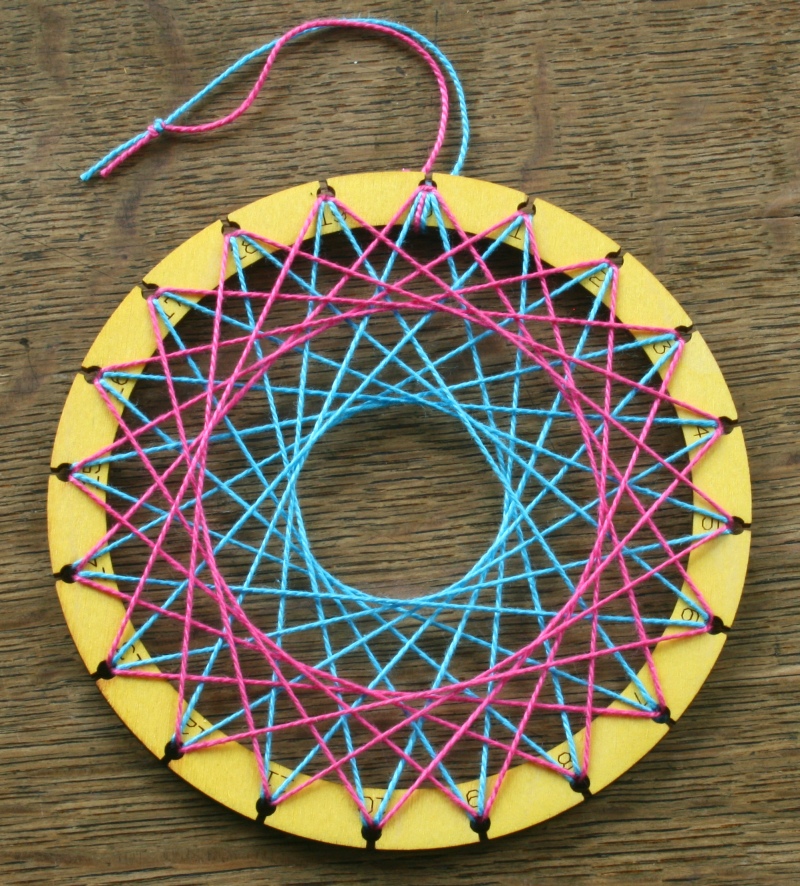
16. When finished with all 30 segments, optionally add another set of 30 strings in a different color with a different selection of k. The above instance started with k = 10 in red, and so added k = 8 in blueish.
Young students may need assist to focus on the algorithmic aspects of the string pattern fifty-fifty after they chief the cartoon.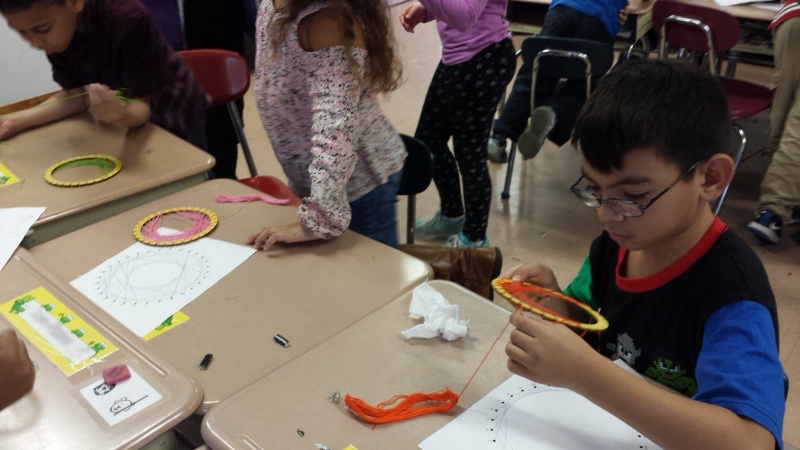
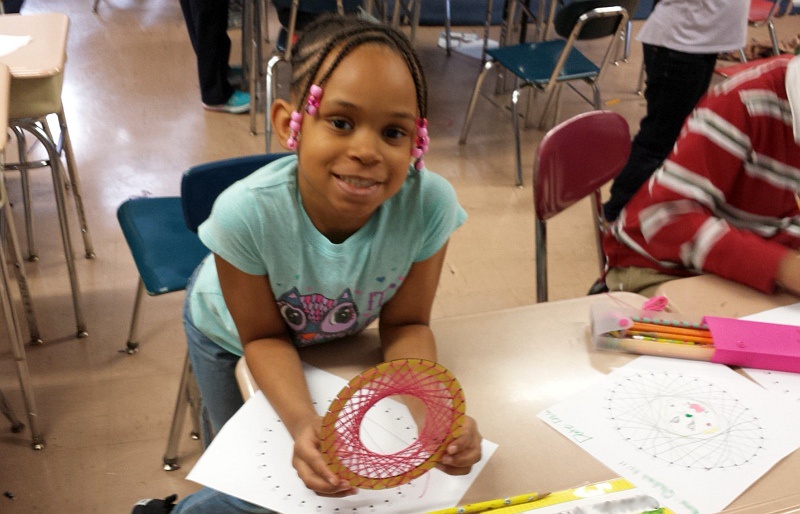
A variation that some students discover natural with the string is to go +10 on the front end and -nine on the back.
Here are steps ten-xvi once again , using the Skip Around method.
10. The Skip Around Method. This is a much better mental exercise in addition. Let m be the chosen "adder," so each line is to go from some i to i+k. In this method we always motility forward chiliad on the front end then make a pocket-sized motion on the back which is always the same. For case, if thou = 10 on a ring of size 30, go from i to i+10 on the front, then frontwards one more to i+11 on the dorsum, so make make some other frontwards +x on the front, then move forrad one more on the dorsum, etc. In this way, all 30 lines eventually get made, but in a different order.
11. Inquire students to open up the embroidery thread, beingness careful non to tangle information technology. Wrap the end around the 0 hole and tie a knot to get-go the thread and prevent it from getting loose. Leave a flake of the terminate hanging; it will be useful later, to necktie off the end when consummate.
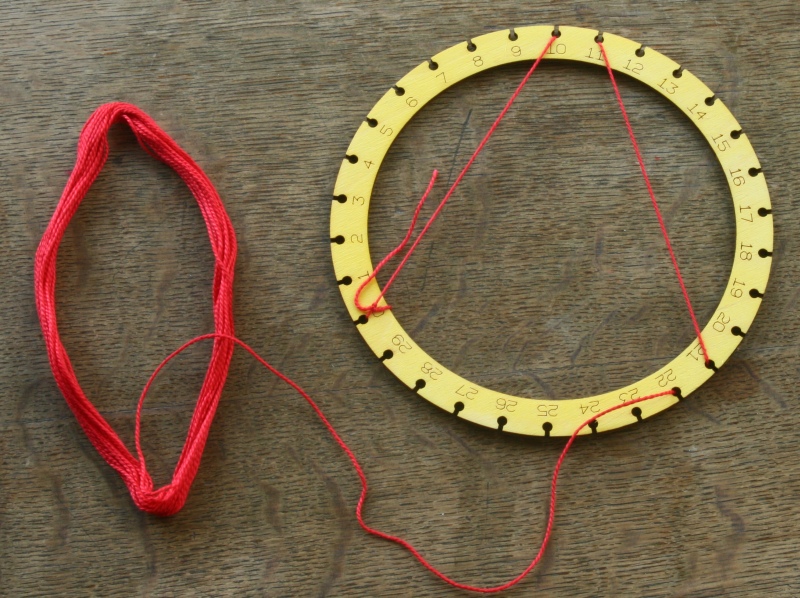
12. From 0, on the forepart go to m. On the back go to k + 1. Proceed the pattern: on the front add k; on the dorsum add 1. Continue the string adequately tight, so the lines stay straight and will non fall out of the holes.
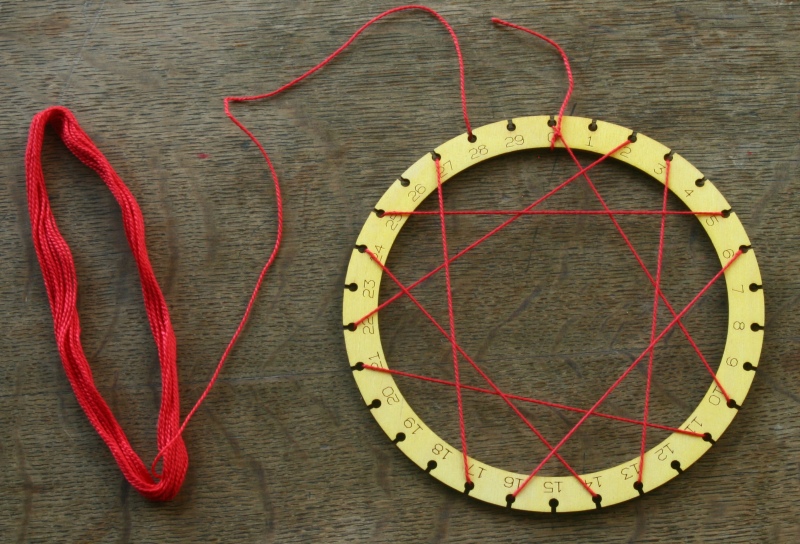
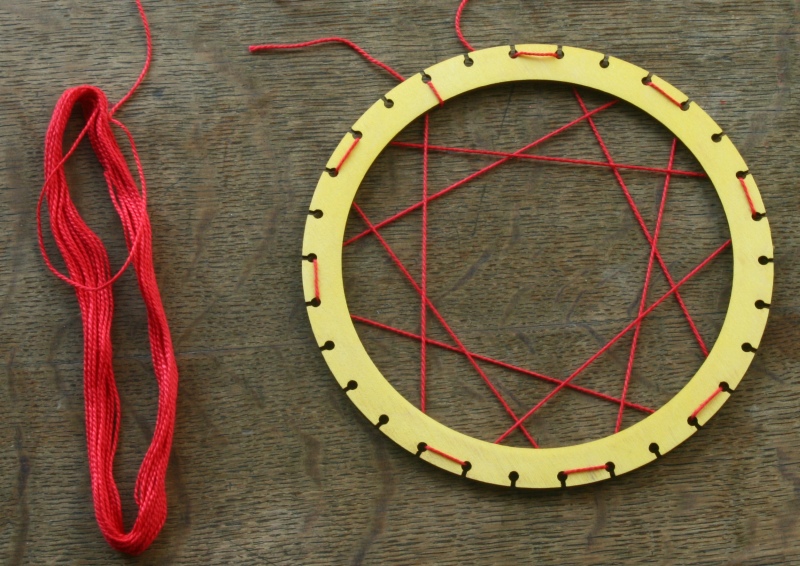
Continue in this way, always going +k on the front and +1 on the back.
13. You lot should eventually stop up back at 0 after making all 30 segments. But if y'all fabricated even one addition error along the manner, then you volition see it doesn't close upwardly properly. After checking for definiteness, tie off the stop. You can get out a hanging loop for displaying information technology a s above, when finished with all xxx segments.
14. Students may now add another set of 30 strings in a dissimilar color with a dissimilar choice of m.
They should discover that the method works well for some choices of k, but fails for certain other choices of thou. This is an opportunity for them to analyze and mathematically model the situation.15. With older students, yous can inquire: What if yard was 14 and you tried this? It wouldn't work! You would get from 0 to 14 on the front end, and so +one to 15 on the back, then +fourteen to 29 on the front, so +1 on the dorsum brings you to 0 again, and that pigsty is already consummate. Ane approach is that when
e'er yous come to the front where y'all already accept a string , just move forward an extra one on the back, to get to a new position that needs a string. This works fine, but a mathematical purist volition be unhappy that the back isn't perfectly symmetrical. A different arroyo for k = 14 is to go -1 on the dorsum each time (instead of +i every time). This works consistently for all thirty lines. One can experiment and see that going -1 on the back would non piece of work when k=x, though +1 on the back did work. So for each k, there are choices for the back which practise not work and choices which do work. Which work? This is a good problem to pose to students familiar with prime numbers and factoring. They may want to employ the sheets with numbered dots to help understand the cases.Example with 20-Hole Ring
The dorsum has all the -i steps. Here, we have added a second layer, going +6 on the forepart and +one on the back.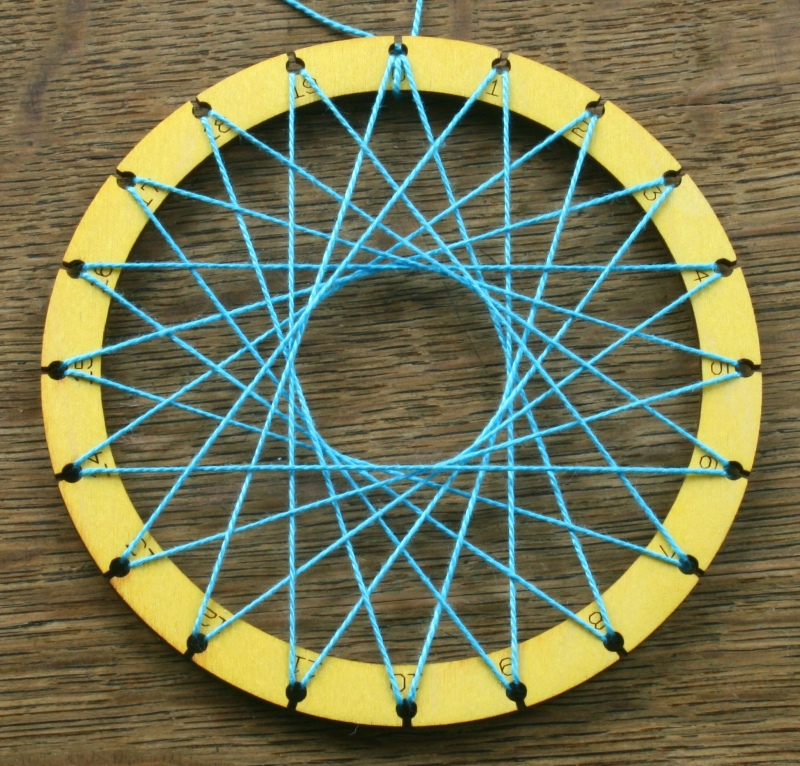 For this example, you lot can go +viii on the front and -i on the back.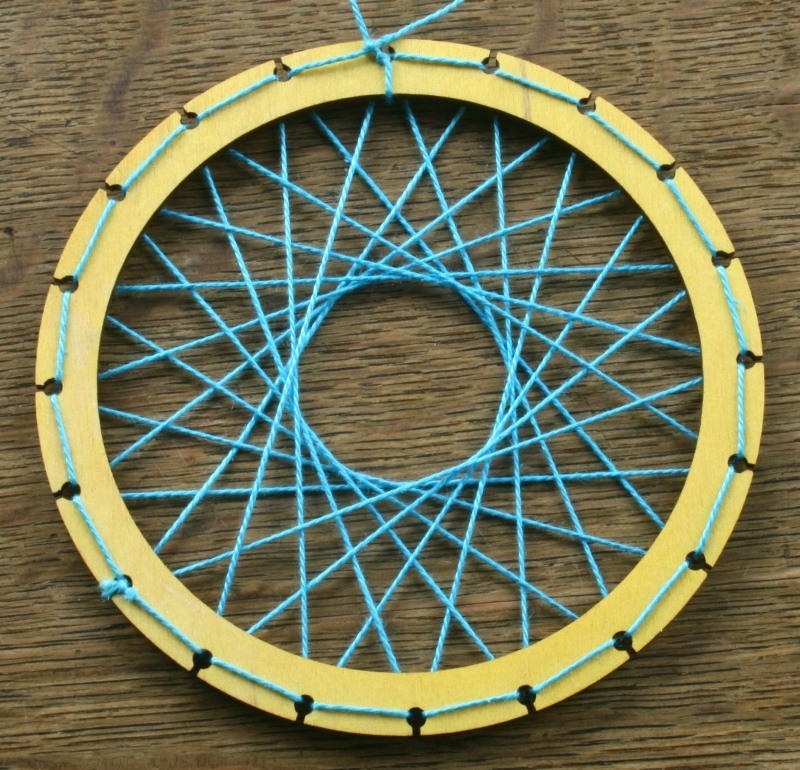
Part C. Decision
With older students, yous can talk over why the dorsum-and-along method e'er works and why the skip around method only works for certain choices of what to do on the back. For some choices yous end up back at 0 before all 30 lines have been drawn. To understand what is happening, recollect well-nigh the cyberspace motion after moving k on the forepart and j on the back. This brings you to a new hole on the front, where you lot repeat. If one thousand + j divides evenly into 30, then it ends too shortly and you need to do something a lilliputian different on the back to continue. If
k + j is 7, eleven, or 13, it works fine, e.g., 10+1 or 14-i. In general, if k + j has whatsoever divisor greater than one in mutual with the number of holes, the procedure ends too shortly. So you can first choose thou for its aesthetic effect then choose j to make k + j have the value you want.Part D. Optional Extension
. The Cardioid 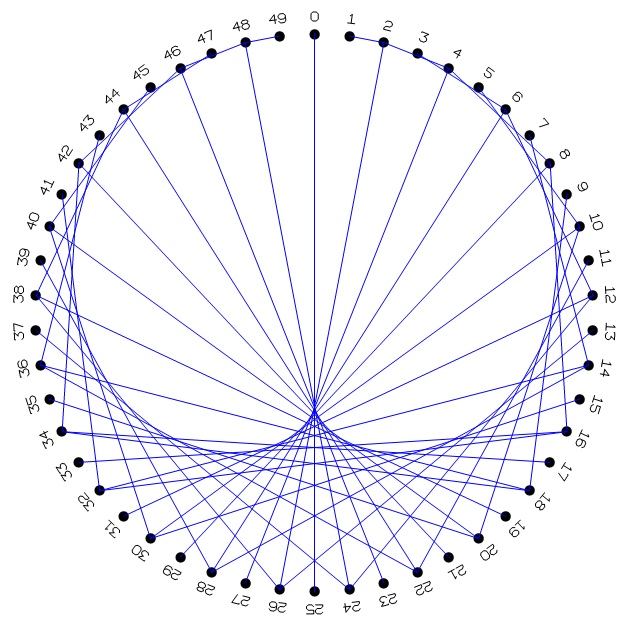
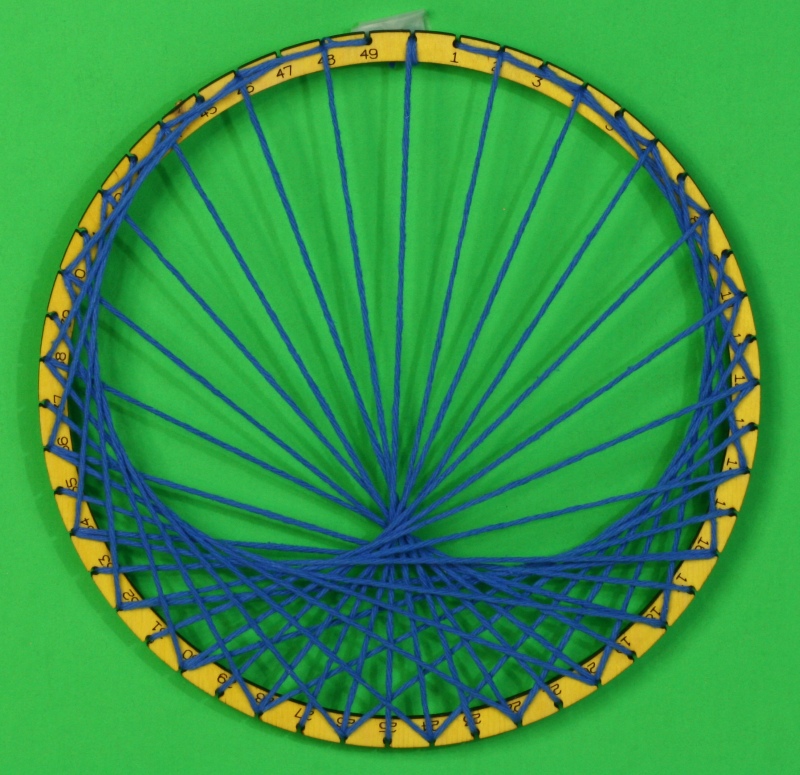
Ask students to consider using a larger band, with 50 or more holes, and connecting each hole i to hole 2 � i. Hand out a canvass with 50 numbered dots and inquire students to draw this on paper start. They should detect that the strings outline (i.e., are tangent to) a curve chosen the "cardioid," because information technology is heart shaped, as shown above. Note: A thirty-dot sheet is not recommended. The shape does not stand out very clearly if in that location are fewer than l lines.
Ask students to plan how they might make the connecting hops on the back before starting construction. Discuss ideas. A modified version of the back-and-forth method works well here, going +i on the dorsum of the ring at the i end of each segment and +2 on the dorsum at the twoi cease of each southwardegment.
Mitt out larger rings or bear witness students how to create very large rings, as described below. If making a 50-hole cardioid, have a length of string bachelor equal to 40 times the bore. For a 100-hole cardioid, take seventy times the bore. Colored yarn works well with the larger rings.
For the modified back-and-along method, southtart past adhereing the string at 0, going on the back to 1, on the front to ii, on the back to four, on the front to 2, on the back to 3, on the front end to half-dozen, on the back to 8, on the front to 4, on the back to 5, on the front to ten, on the back to 12, etc.
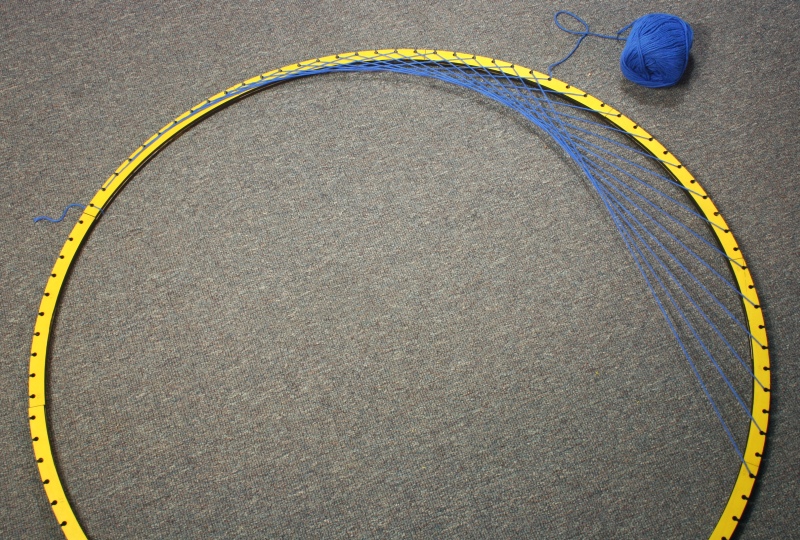
Higher up is the state on a 100-pigsty actress-big ring later the i end has reached 25 and the 2i finish has reached 50.
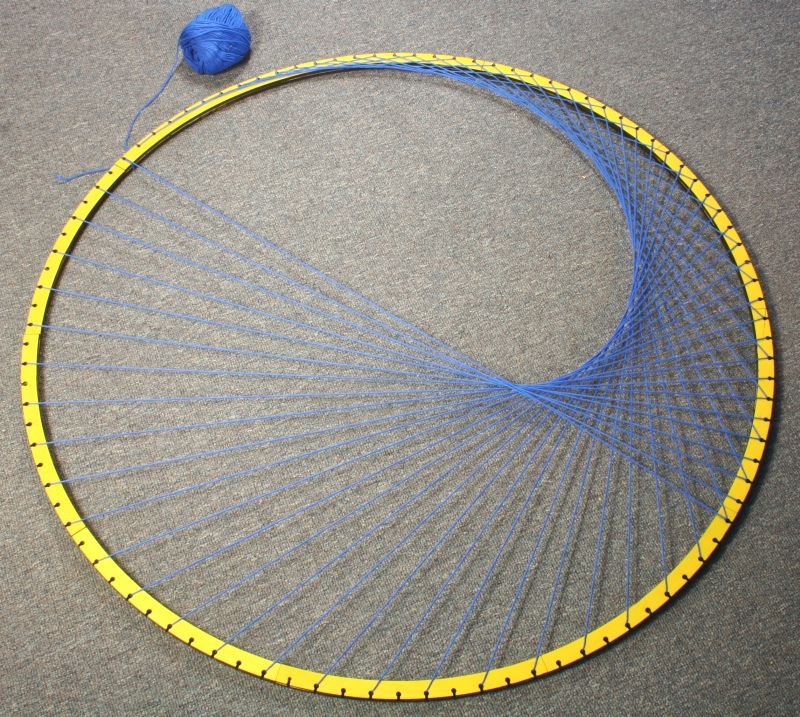
Above is the halfway point. The iii end has made a complete revolution while the i end has gone half fashion around. The completed cardioid is shown at the tiptop of this page.
Optional Extensions
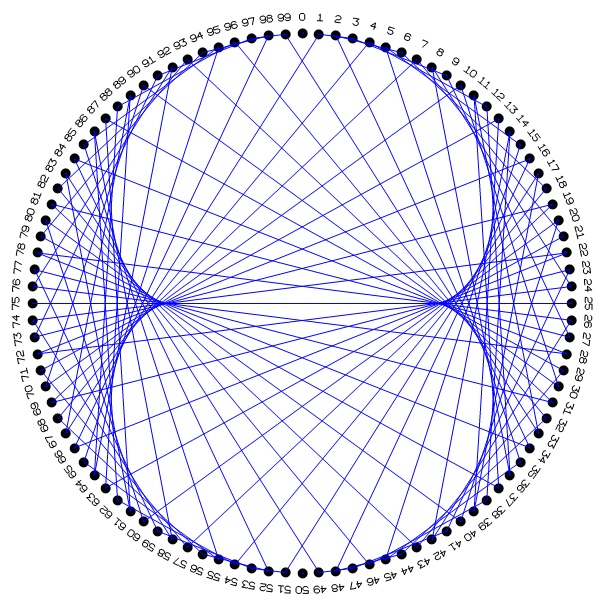
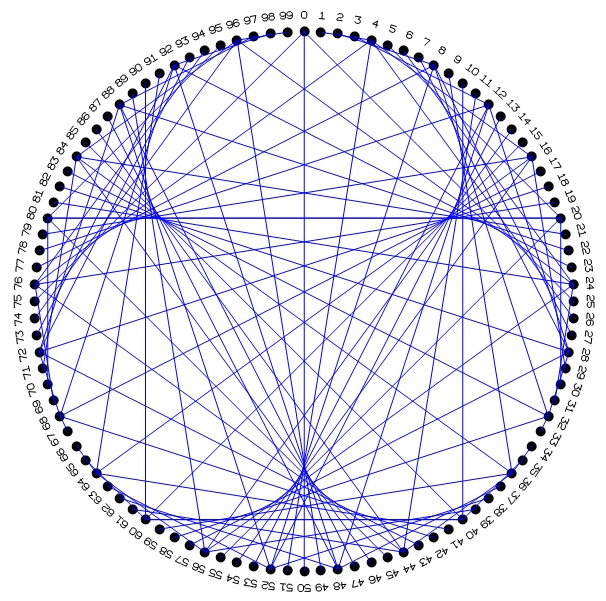
Across the cardioid. If you connect pigsty i to hole 3 i you lot get the two-lobed pattern at left in a higher place, chosen a "nephroid." If yous connect i to 4i , y'all get the three-lobed pattern at right. This one does not have a special name equally far as I know, merely it is "an epicycloid of three cusps" but every bit the nephroid is an epicycloid of two cusps and the cardioid is an epicycloid of one cusp. These need a band with more than than l holes to be clearly visible. Predict what happens if you cull another k and connect each hole i to hole thou� i.
Other Materials. Notice other materials to utilize as the ring, east.g., a hula hoop or an old bike rim. Or curve a long sparse strip of woods into a circumvolve and marker locations to attach the strings. You can run string between nails hammered into a wall or a board.
Larger Versions. Can you pigment a mural-size version ? Or use sidewalk chalk in a parking lot. How would you mark north equally spaced points on a very large circumvolve? How would you lot describe the long straight lines between points?
Detailed Instructions to Make Larger Rings
Time Required:
-
0.5 hour to mucilage, not including drying time and attaching the strings
Materials
- 20 laser-cut arcs made of 1/iv-inch thick plywood using this 60-hole template or this 100-pigsty template
- forest gum (e.k., Titebond Ii)
- glue brushes
- clamps or clothes pins to hold the parts together while drying
- The in a higher place activeness with jumpsuit rings should be done outset, so students sympathize the purpose of these larger rings.
- The arc is one 10th of a circle, but twenty pieces (2 total circles) are required to make a band, because of its double-layer structure.
- These templates are scaled to brand a ring three feet in diameter with an efficient use of wood. They tin can be scaled to arbitrary size. T o ensure rigidity, if you calibration them to be larger, either utilize thicker plywood or extend the process beneath to use 30 arcs in three layers.
- Students tin can piece of work in groups of two to four to make a ring, and so string it as a group.
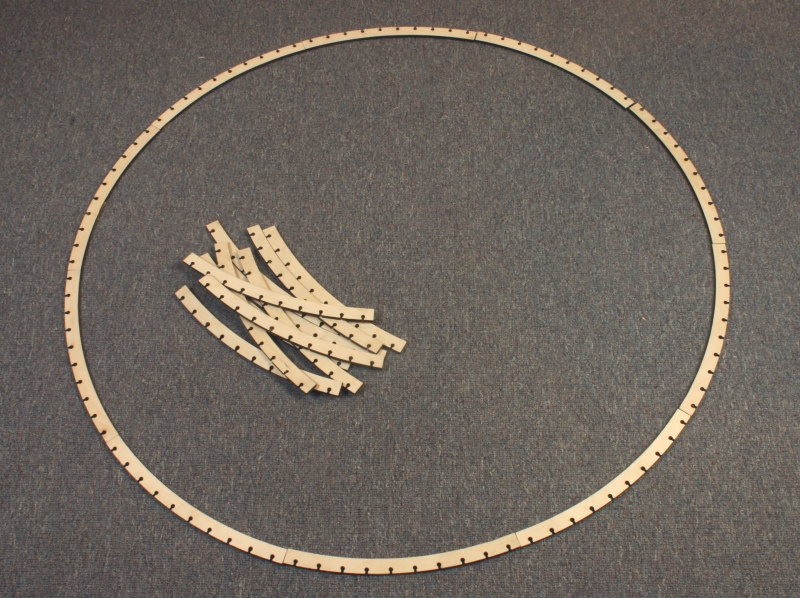
i. Distribute the parts to the groups. Ask students to lay out ten pieces in a neat circumvolve on the floor, so they get a sense of its scale.
ii. Ask students to lay out the second set of 10 pieces on top of the start ten, so each piece in the superlative layer halfway overlaps two pieces in the bottom layer. (For the lx-pigsty ring, each arc has 6 holes, so in that location should be a iii-hole overlap. For the 100-hole ring, each arc has ten holes, then there should exist a 5-hole overlap.)
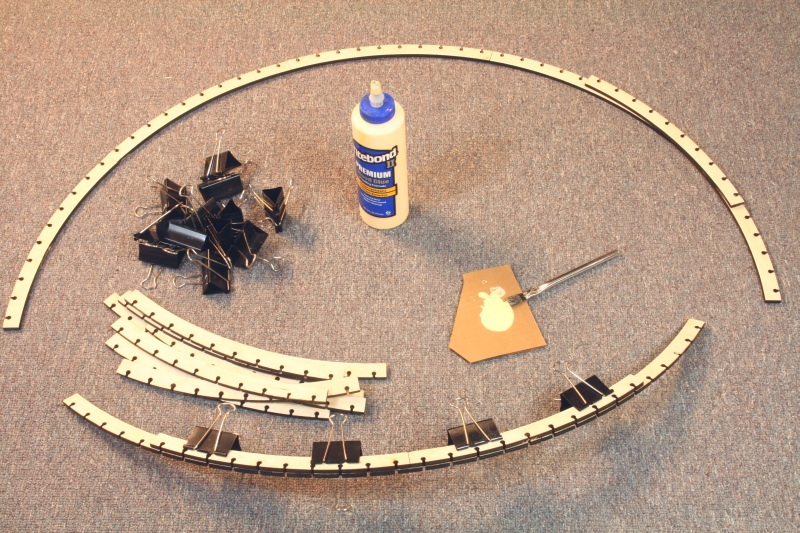
3. Hand out mucilage brushes and squirt some glue on to a scrap of cardboard or a similar palette for each grouping.
4. Instruct students to carefully brush mucilage on both surfaces that volition join and to use just a small amount of gum---just enough to moisture the surfaces. Too much glue makes a mess, takes longer to dry out, and doesn't make the joint any stronger.v. Employ the clamps to hold the ii layers together. Be sure the holes are well aligned, as the string volition accept to pass through both layers. Wipe off whatsoever excess glue with a newspaper towel.
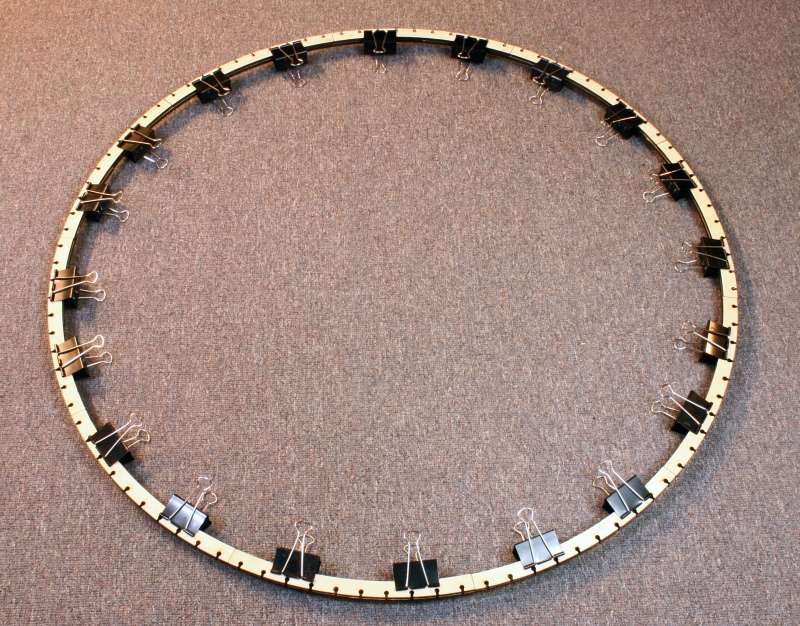
6. Allow undisturbed drying time for the mucilage to harden before removing the clamps.
seven. The holes can exist numbered with a pencil. It is sufficient to just label the multiples of v.
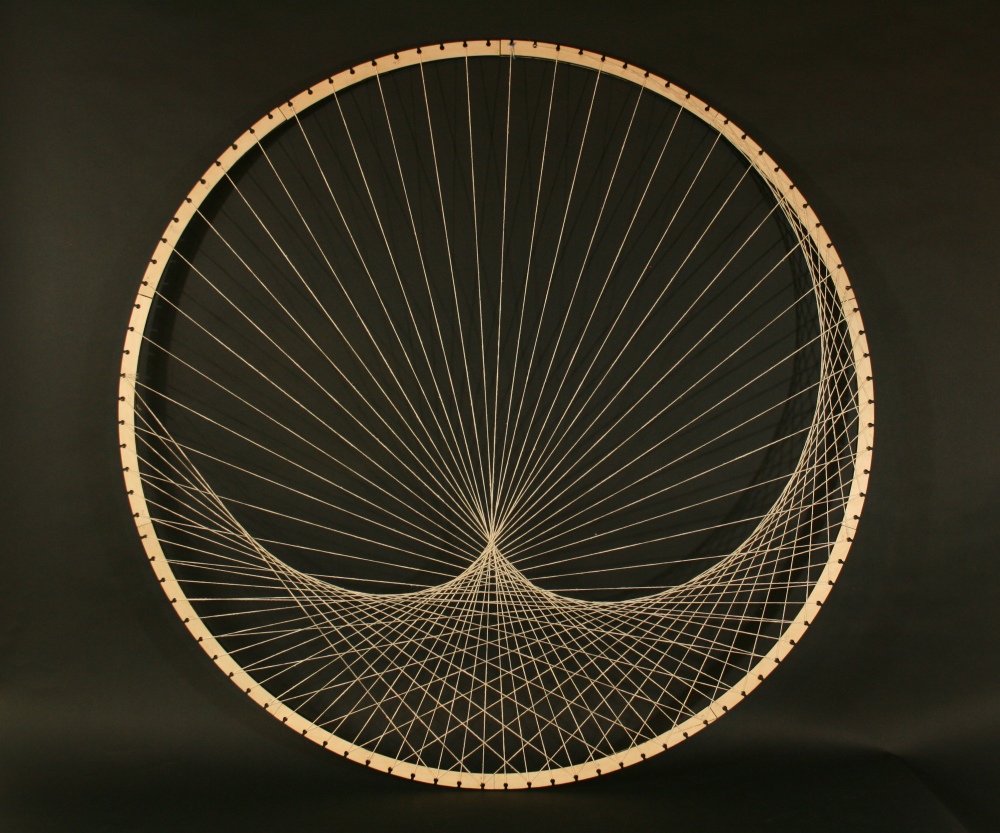
8. Utilize the rings as above to make big, impressive string figures. Colored yarn works well. In a higher place is a three-quarters complete cardioid on a 3-foot diameter ring of 100 holes.
ix. Y'all can encounter the back of the ring here, which makes clear how the back and along method works.
Source: https://makingmathvisible.com/String-Rings/String-Rings.html
0 Response to "String Art and Math a Project in Multiplication String Art and Math Pdf"
Post a Comment