Sigma 14mm F1 8 Dg Hsm Art Front Filter
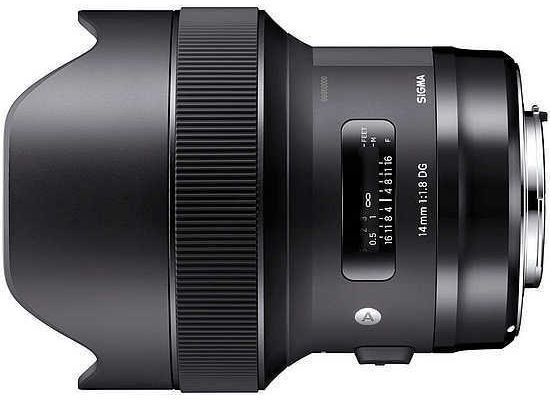
Introduction
The Sigma 14mm f/1.eight DG HSM Art lens stole the headlines as the beginning ultra-wide angle lens for full-frame cameras to break the f/2 barrier. No other ultra-wide bending rectilinear lens is as fast. Fast ultra-wide bending lenses are a rarity and your choices in this category are few. On paper, this lens is finger licking practiced.
What is more, the 14mm f/1.8 lens is function of Sigma's highly acclaimed Art series, boasting lenses that consistently review really well. This is the widest ane of seven autofocus prime lenses in the range. Of these, it's the largest, heaviest and well-nigh expensive. This lens is an impressive beast.
14mm is a focal length particularly popular with astrophotographers. It's tough to obtain precipitous and vibrant images in the low contrast night calorie-free - y'all need all the light intake you can go. Therefore, it'southward easy to run across the huge appeal to this unrivalled fast f/ane.8 aperture lens.
We, of course, couldn't aid ourselves and headed out with the lens for some night shots. Yet our test doesn't end in that location. Ultra-wide angle lenses are decumbent to distortions. Sigma claims to have handled distortions really well. Our test will reveal how well.
Equally for total-frame contest, the excellent manual focus Samyang 14mm f/2.4 AE XP is as close as it gets specification wise. Canon and Nikon accept their ain 14mm prime lenses, each with a maximum f/2.eight aperture - though Nikon'south is getting on a bit now. Nikon also has its 14-14mm f/2.viii lens, while the recently reviewed transmission focus Laowa 12mm f/2.8 offers a wider perspective.
The Sigma lens may well win the aperture race, only how does it handle and what is the prototype quality like? Read on to detect out.
Ease of Use
The first thing you'll annotation well-nigh the Sigma 14mm f/1.8 DG HSM Art lens is just how heavy information technology is - a whopping 1.17kg. Attached to the formidable Catechism EOS 5D Mk Iv (our camera of selection for this examination) and the combination is even getting a picayune front heavy.
The lens isn't exactly small either, peculiarly the front half that hosts the bulbous forepart lens elements. We have the Laowa 12mm f/ii.8 Zippo-D lens in the office and the contrast between the two lenses is stark (bank check out the picture for comparison).
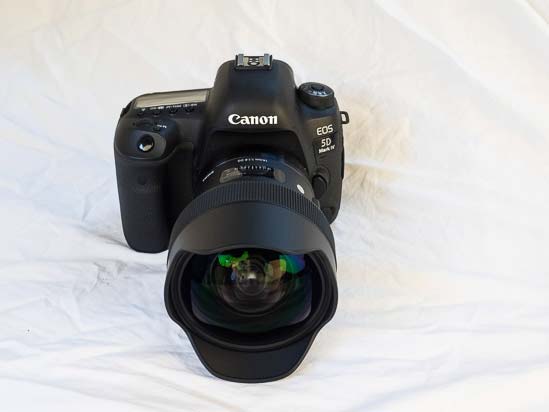 The Sigma 14mm f/1.eight DG HSM Art lens mounted on a Canon EOS 5D Mark IV
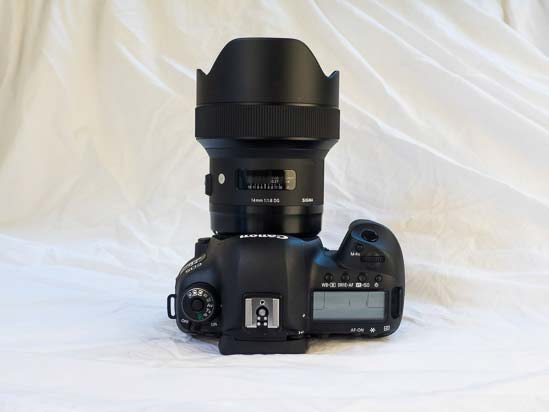 The Sigma 14mm f/one.eight DG HSM Art lens mounted on a Catechism EOS 5D Marking IV
This is unmistakably a Sigma Art lens - the blueprint is consistent through the entire range. If you've used i, the formula is the same for the rest. All the lenses have a weight to them and experience solid in the paw. The focus ring has a ribbed condom grip for a business firm hold and rotates smoothly plenty.
Although Sigma Art lenses experience high-draw, none are weather sealed. An Achilles heal in the stance of some. Still, when out on a common cold British nighttime, the Sigma 14mm f/ane.8 DG HSM Art lens keeps out condensation and the like. Nosotros haven't truly pushed the lens in tough inclement conditions or shooting conditions, but it'southward held up so far.
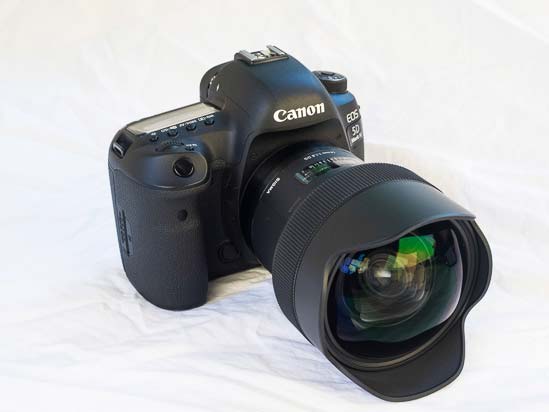 The Sigma 14mm f/1.eight DG HSM Art lens mounted on a Canon EOS 5D Mark 4
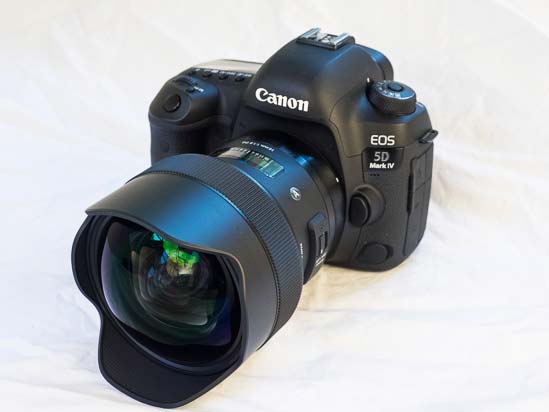 The Sigma 14mm f/1.eight DG HSM Fine art lens mounted on a Canon EOS 5D Mark Four
Of course, there is no lens filter thread - the gargantuan forepart lens element protrudes from the barrel. If you want to attach ND filters and the like, a specialist filter holder kit is needed.
Sigma recently announced the FHR-11 rear filter holder for the Catechism-fit version of the lens but. There are no plans to brand one for the Nikon and Sigma fit versions because it'south not possible to implement this blazon of filter. Nosotros're not sure if a front filter holder is bachelor for this lens notwithstanding. Non that astrophotographers need such filters.
 The Sigma 14mm f/1.8 DG HSM Fine art lens mounted on a Canon EOS 5D Marking 4
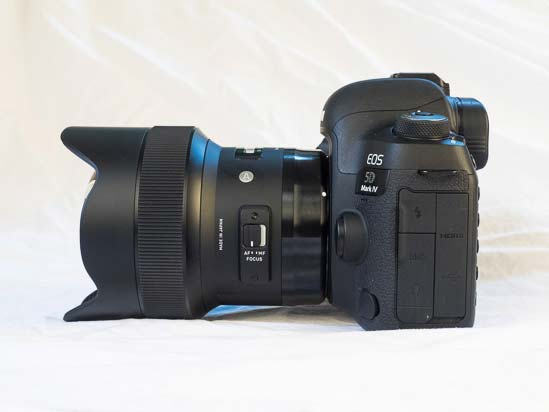 The Sigma 14mm f/1.8 DG HSM Art lens mounted on a Canon EOS 5D Mark IV
 The Sigma 14mm f/1.8 DG HSM Art lens alongside a Canon EOS 5D Marking Iv
That front end lens element needs as much protection equally it can get, given how information technology sticks out and so. A supplied lens cap is lined with felt and slips and grips the protective built-in lens hood in perfect harmony. You'll have no fiddles moving the lens hood on and off, or worries that it will slip off.
This is an autofocus lens. All in all the AF seems reliable, but hey nosotros're using it with the Canon EOS 5D Mk 4, so it has a good partner there. Still, the focusing motor is really quiet.
 Side of the Sigma 14mm f/1.8 DG HSM Art lens
 Side of the Sigma 14mm f/i.eight DG HSM Art lens
 Side of the Sigma 14mm f/1.8 DG HSM Art lens
 Side of the Sigma 14mm f/1.viii DG HSM Art lens
We would also say that with a bit of torchlight and the excellent AF organisation of the photographic camera in use, AF proved fast and sharp even under moonlight.
There is a question of how great a need there is for machine focus in an ultra wide angle lens. Such lenses are usually used for astrophotography, landscapes and compages - all of which afford the time to achieve a sharp focus manually. Indeed, we mainly used transmission focus during this test.
 Front end of the Sigma 14mm f/i.eight DG HSM Art lens
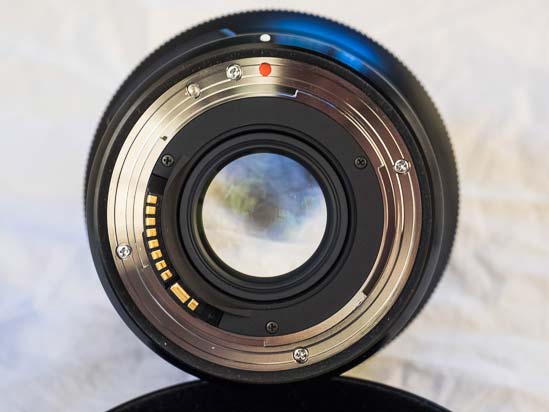 Rear of the Sigma 14mm f/1.8 DG HSM Art lens
A moving ridge of new transmission focus ultra-wide angle prime lenses are coming out of China and Korea, for a fraction of the toll. The contest to the large boys Nikon and Canon is heating upwards. Thank you largely to the Fine art series, we count Sigma as part of this esteemed company now - frequently exceeding them.
We'll never knock a product for offer what some users may run across every bit surplus - you tin can't downgrade a lens because it has automobile focus! It's up to the user to judge whether or not the feature volition come in handy. Nonetheless, on the face of it you're paying twice the price for the pleasure.
 Front of the Sigma 14mm f/one.8 DG HSM Art lens
 Rear of the Sigma 14mm f/1.8 DG HSM Art lens
We're not writing off AF for a lens similar this - it could exist used for activeness photography when the lensman needs to become really close to the action while keeping the environs in the shot. AF is really handy for a few occasions and reassuring to know information technology's there.
All in all, there is no doubtfulness this is a serious lens. Its fast f/1.8 aperture comes at a toll - the lens is heavy and expensive. How much yous need that extra stop of light is your call, but from our images which you volition see before long, the lens is transformative for photographing in low light.
 The Sigma 14mm f/one.8 DG HSM Art lens in-manus
Focal Range

The 14mm focal length gives an angle of view of 114.2° on a full-frame sensor.
Chromatic Aberrations
To check for Chromatic Aberrations (CA), we switched off all lens corrections in camera and take looked at the raw image files.
The advent of chromatic aberrations is present here and in that location and of class more so when the Sigma 14mm f/1.8 DG HSM Art lens is wide open up. It'due south not difficult to find green and purple fringing around hard silhouettes.
We have seen slightly better control in other premium ultra-wide bending lenses when wide open up, like the Laowa 12mm f/ii.viii Zero-D. Nevertheless CA is controlled better when the Sigma lens is set to an optimum aperture. Thank you to its wider maximum discontinuity, you'll go to these optimum apertures sooner than in other lenses.
Overall the control of CA is pretty good and where present it can exist removed with relative ease using editing software. Usually, moving the corrections amount upwardly to 3 in Adobe Lightroom will remove all CA.
Calorie-free Fall-off

Light fall-off (vignetting) is virtually pronounced at the wide open apertures and tends to disappear at the optimum apertures. The Sigma 14mm f/ane.viii DG HSM Art is at a singled-out advantage then, because information technology'due south widest aperture is unmatched.
When wide open at f/i.8, vignetting is pronounced - it is to exist expected. Notwithstanding, even the centre of the frame is affected. Cease the lens down to f/4 and vignetting is nigh gone and it'south completely gone at f/5.6. The widest aperture in many other ultra-broad bending lenses is f/iv, where vignetting is unremarkably quite obvious.
Compare the performance downward the apertures, and the Sigma 14mm f/1.8's control over vignetting is rather skilful than exceptional. Yet, the key here is that you'll get to the vignette-less apertures sooner than other lenses, thank you to the faster maximum aperture.
So, when comparing similar for similar apertures, e.g. Sigma 14mm f/1.eight set to f/two.8 and the Laowa 12mm f/2.viii fix to f/2.8 and the Sigma comes out on top by quite some margin.
Regardless, corrections to vignetting tin can be made using editing software - though corrections may need to be made manually because the lens does non have a profile in all editing software.
Distortion

Sigma claims that the lens demonstrates excellent command over barrel distortion. We have not tested this lens in a controlled lab setting. Our observations come up from our brick wall test and more importantly real earth images.
We've taken numerous pictures of buildings - for architectural images straight lines mean everything. We tin say that barrel distortion is very well controlled. With the camera positioned horizontally to a building, vertical lines are straight.
The brick wall test shows slight horizontal curvature in the edges of the frame, merely nothing that would compromise high-quality architectural images.
Astigmatism

The corners of images taken using the widest aperture of an ultra-wide bending lens are particularly susceptible to astigmatism. This baloney makes the stars that would otherwise be dots in the night sky look more similar crosses (known equally batwing coma).
Looking over our images we note minor astigmatism similar to other leading ultra-broad angle lenses. All the same, astigmatism is some other example where the wide f/1.8 maximum aperture gives the Sigma 14mm f/1.eight DG HSM Art lens the edge over competitors.
Stop the lens down to f/two.8 or f/4 - which is the widest aperture of most competing lenses where astigmatism is present - and astigmatism is very well controlled in the Sigma lens. Bravo again to the unrivalled fast discontinuity.
Macro

This is anything but a macro lens, with a minimum close focusing distance of 27cm and maximum magnification of one: ix.8. This uncropped image shows how shut yous tin get to a Compact Flash carte du jour.
Sharpness
In order to show you how abrupt this lens is, we are providing 100% crops on the following folio.
- Ease
of Use - Sample
Images - Lens
Specs - Rating &
Conclusion - Main
Rivals - Review
Roundup
Source: https://www.photographyblog.com/reviews/sigma_14mm_f1_8_dg_hsm_review
0 Response to "Sigma 14mm F1 8 Dg Hsm Art Front Filter"
Post a Comment