Upload a File Into the Datastores of a Virtual Machine Drive Using Esxi
If control lines are your bread and butter, you lot probably already know nearly esxcli commands and how they are used to perform direction and configuration tasks on ESXi. If on the other mitt, the esxcli system is all new to you, this post will hopefully give you a head start. For the fourth dimension being, you merely need to know that esxcli commands are run from the ESXi shell. If the command line is something you lot want to delve into, consider having a await at the PowerCLI Primer serial. With that out the way, allow's get on with the show labelled as Top 20 Essential ESXCLI Commands You Need to Know.
ESXi Shell and ESXCLI
If it is not already, the first thing you demand to practice is enable crush on ESXi, something that is generally disabled for security reasons. To enable Shell, follow the steps provided in KB 2004746 . In one case you enable information technology, yous tin utilise a tool like putty to access Shell via an SSH session. Alternatively, pressing ALT-F1 while in DCUI is ane other way of accessing Shell. To run commands in shell, log in as root or with an account having similar privileges.

Accessing ESXi shell using an SSH customer or straight from panel
The esxcli command list exposes a number of namespaces against which you can run queries to retrieve information near ESXi likewise equally configure (it.) the unabridged esxcli arrangement. The following table lists the available namespaces on ESXi along with a description for each (source: VMware) . For earlier ESXi releases, consult the relevant online documentation or run esxcli with no parameters to see which namespaces are available.
| Control | Clarification |
| esxcli device | Lists descriptions of device commands. |
| esxcli elxnet | Lists descriptions for commands that manage Emulex elxnet drivers. |
| esxcli esxcli | Lists descriptions of esxcli commands. |
| esxcli fcoe | FCOE (Fibre Channel over Ethernet) commands |
| esxcli graphics | Graphics commands |
| esxcli hardware | Hardware namespace. Used primarily for extracting information about the electric current organization setup. |
| esxcli iscsi | iSCSI namespace for monitoring and managing hardware and software iSCSI. |
| esxcli network | Network namespace for managing virtual networking including virtual switches and VMkernel network interfaces. |
| esxcli nvme | Commands for managing NVMe devices. |
| esxcli rdma | Commands for monitoring RDMA devices. |
| esxcli sched | Manage the shared system-broad swap infinite. |
| esxcli software | Software namespace. Includes commands for managing and installing prototype profiles and VIBs. |
| esxcli storage | Includes core storage commands and other storage management commands. |
| esxcli system | System monitoring and management command. |
| esxcli vm | Namespace for listing virtual machines and shutting them downward forcefully. |
| esxcli vsan | Namespace for Virtual SAN direction commands. See the vSphere Storage publication for details. |
The Meridian 20 ESXCLI Commands
The following is a compilation of esxcli commands in vSphere, sorted by namespace, which I tend to use on a regular basis. It is by no ways exhaustive as at that place are too many examples to mention. If you want the whole shebang, accept a look at VMware'south documentation site .
System related commands
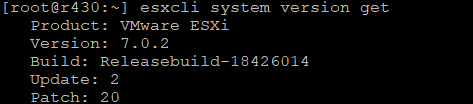
#i: esxcli organisation version get
Clarification: Returns the ESXi build and version numbers.
#2: esxcli system hostname get
Clarification: Returns the hostname, domain and FQDN for the host.

#3: esxcli system stats installtime become
Description: Returns the date and fourth dimension of when ESXi was installed.

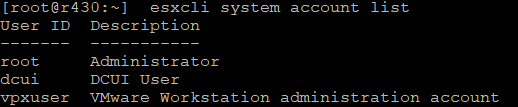
#4: esxcli arrangement account list
Description: Lists the local users created on the ESXi host.
#5: esxcli system account add -d 'Altaro Guest' -i altaro -p dsfewfewf*3!4404 -c dsfe
wfewf*3!4404
Description: This command allows yous to create local ESXi users. All the parameters used in the ESXI host example are mandatory.

#vi: esxcli system maintenanceMode set –enable true
Clarification: Use this command to put ESXi in maintenance mode or take it out.

#vii: esxcli organization shutdown reboot -d 10 -r "Patch Updates"
Description: Use this command to reboot or shutdown ESXi. The -d parameter is a countdown timer; minimum x seconds. ESXi must be in maintenance mode before you tin use the command.

Network related commands
#8: esxcli network firewall get
Description: Returns the status of the ESXi firewall. The default activity is to drop traffic unless immune through by a specific firewall rule. The Enabled field indicates whether the firewall is enabled. The Loaded field shows whether the firewall module is active or not (see esxcli firewall load | unload commands).

#9: esxcli network firewall set –enabled true | false
Description: Use this esxcli command to disable the ESXi firewall for troubleshooting purposes. Note that disabling the firewall on ESXi is highly discouraged.

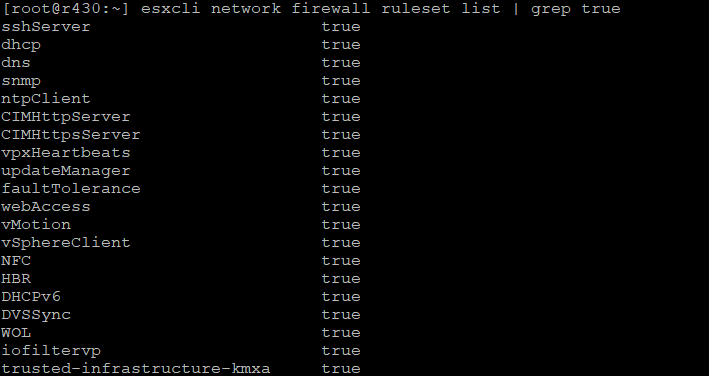
#x: esxcli network firewall ruleset listing | grep true
Clarification: Generates a command list of all enabled firewall rules on ESXi. The command is piped to grep which will matches the value "truthful" so but enabled rules are displayed.
#11: esxcli network ip interface ipv4 become
Description: Displays the IPv4 configuration for all the interfaces present on ESXi.

Software related commands
#12: esxcli software vib list
Description: Lists all the currently installed VIBs on ESXi. A VIB is a file packaging format used to distribute software on ESXi.

#thirteen: esxcli software vib update -d "/tmp/update.aught"
Description: Utilise this esxcli command to update an installed VIB on ESXi. Note that the control does not install any new software. Instead it merely updates what'south currently installed. Use esxcli software vib install instead when installing new software. The -d parameter specifies the full path to the packet being used for the update. As per the side by side screenshot, I specified a not-existing patch hence the error message.

Virtual Car related commands
#14: esxcli vm process list
Description: Lists all the running VMs on the hosts. The World ID can exist used with other esxcli commands to conduct out various tasks related to VMs.

#15: esxcli vm procedure kill -w 69237 -t soft
Description: Utilise this command to kill a running VM such equally one that fails to respond to commands. You must first retrieve the VM'due south Globe ID (come across control #14) and pass it on using the -w parameter. The -t <soft | hard | strength> mandatory parameter sets the type of kill operation. First with soft and then you let the VM to close downwardly cleanly. If this does not work, endeavour the hard selection which volition kill the VM processes immediately as in kill -9 . The Force type should only be used every bit a final resort. If none work, your simply selection is to reboot ESXi.

Storage related commands
#sixteen: esxcli storage vmfs extent list
Description: The control generates a listing of extents for each volume as well as the corresponding device proper noun to UUID mapping.

#17: esxcli storage filesystem list
Clarification: The control lists of all the volumes or datastores accessible by the ESXi host. The output includes the file system type, disk info along with the volume proper noun, path and UUID.
iSCSI related commands
#18: esxcli iscsi software set –enabled true && esxcli iscsi software get
Description: The above control actually consists of two concatenated commands, which is what && does. The get-go command enables the iSCSI software adapter and the 2nd verifies that the iSCSI adapter is enabled.

#xix: esxcli iscsi adapter param go -A vmhba65
Description: The command returns metrics for the specified iSCSI adapter. These include the current, minimum and maximum values and whether the listed parameters may be configured or not. The proper noun of the iSCSI adapter you want to be queried is specified via the -A parameter. The adapter name is retrieved using esxcli iscsi adapter list or from the vSphere Web client.

Available ESXCLI commands
#20: esxcli esxcli control list
Description: Lists all the available namespaces and corresponding commands.

Wrap Upward
We've seen how you can employ esxcli to query ESXi as well every bit it for configuration tasks. Information technology is a not bad command line interface to chief, and then make certain you familiarize yourself with it. Hopefully, this post has given you a sense of taste of what it can do and how control line is sometimes improve suited at accomplishing a given task such every bit upgrading ESXi from the command line, something I explicate in Patching and Upgrading ESXi using ESXCLI commands .
Source: https://www.altaro.com/vmware/top-20-esxcli-commands/
0 Response to "Upload a File Into the Datastores of a Virtual Machine Drive Using Esxi"
Post a Comment